Papua New Guinea is one of the most linguistically and culturally diverse countries in the world. Its population is around 10 million, and is home to more than 800 distinct languages and 1000s of cultural groups, many maintaining traditional practices, knowledge systems, and governance structures. Tok Pisin, Hiri Motu, and English are the official languages, but local languages dominate daily village life, meaning multilingualism is the norm.
Diversity is also expressed through art, ritual, and performance. Ceremonial practices, such as singsings (gatherings with dance, music, and costume), vary widely across regions and are used to affirm alliances, resolve conflicts, and celebrate milestones.
Te Papa is proud to be a participant in Wan Bel – a global collective exhibition which celebrates Papua New Guinea cultural heritage through a growing network of nearly 40 international museums and a central digital platform on the occasion of PNG's 50th anniversary of independence.
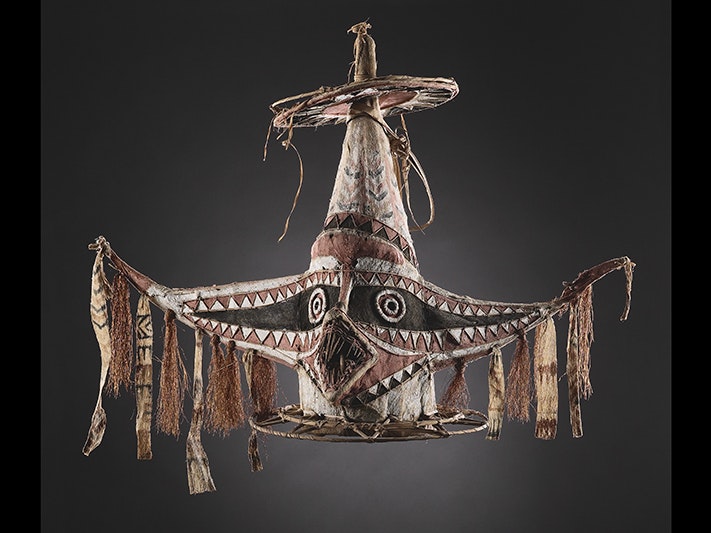
Te Papa’s collection from Papua New Guinea includes impressive dance masks made from tapa (barkcloth), which were worn in the early 1900s during ceremonial rituals. View some of the masks and find out about their different uses.
Tribes in Papua New Guinea used these Eharo masks for a ritual celebration that could last for years. Made of cane, tapa cloth, and painted with natural pigments, they were usually burnt after use, which makes the ones at Te Papa especially rare.
Look Within 2 (2007) by Papua New Guinea artist Daniel Waswas depicts four images of the same person, conveying a message of self-reflection and addressing the idea of identity from within one’s own background.
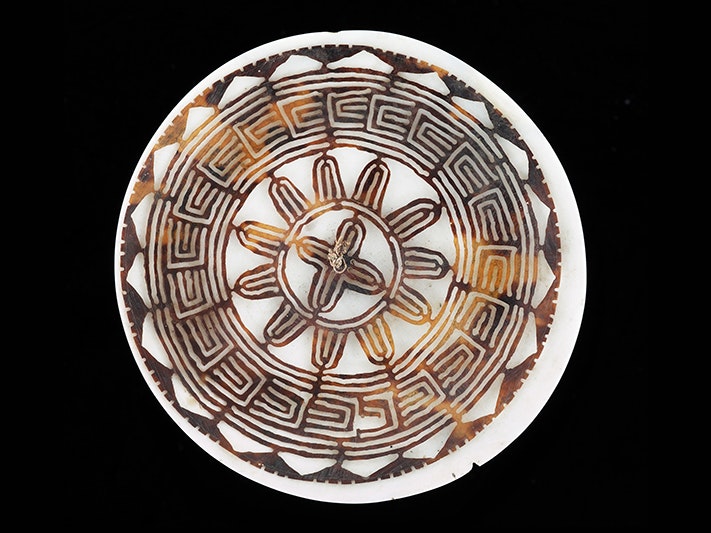
Kapkaps, as ornaments like this are called, are found in parts of Papua New Guinea and the Solomon Islands. These shell disks overlaid with delicate turtle shell filigree are much admired. Attached to a cord or woven band of fibre, they can be worn on the forehead, breast, or shoulder.
The women of Gona village, Papua New Guinea, made this cope (priest’s vestment) as a farewell gift for the Reverend Wardman in 1962. The Anglican missionary had lived and worked with the community for 12 years.
From the 1980s–1990s The Phantom emerged on battle shields during a period of inter-tribal fighting in parts of the Papua New Guinea highlands. For a brief period, the Wahgi people re-painted old battle shields, including representations of ‘good guys’ like the Phantom to capture some of his symbolic power and incite fear amongst their opponents.
Conservator Catherine Williams investigates one of Te Papa’s acquisitions – a painted wooden shield from Papua New Guinea featuring The Phantom – from a conservation perspective.
These battle shields from Chimbu (Simbu) in the Papua New Guinea Highlands are significant for their cultural value and use in warfare among the Chimbu.
Nioge is the term for bark cloth from the Omie people who live in the foothills of Huvaemo and Mount Obo in the Oro Province of Papua New Guinea. View four of the on Collections Online from the artists Botha Kimmikimmi (Hirokiki), Sarah Ugibari, and Brenda Kesi.
Missionary Reverend John Arthur Crump and his family lived on several islands in Papua New Guineabetween 1894 and 1903. During that time, he took many photographs of life in Papua New Guinea. View some of them on Collections Online.
born in the New Ireland province of Papua New Guinea in 1955, David Lasisi moved to Port Moresby to study as an adolescent. The rapidly changing urban environment of Port Moresby was a stark change from the village traditions Lasisi was raised in. The entangled god is one of two prints by Lasisi in Te Papa’s collection, both of which address the presence of customary practices and images in contemporary life.
The Yupin is a male fertility figure made from basket work by the Enga people of the Western Highlands in Papua New Guinea. In 1975, Roger Neich documented the significance of Yupin figures among the Enga people. Here we share images of the Yupin in Te Papa's collections and summarise some of Neich’s findings, and his map of the distirbution of Yupin in the Enga province at the time.
People wore tapa cloth as daily clothing only in the most isolated villages. More often, women made tapa only as it was needed for ceremonial performances and occasions. it was also traded with people from inland villages for items such as pots and feathers. This collection of bo was assembled by Ziska Schwimmer during 1966-67, when she lived with her husband Eric Schimmwer among the Mount Lamington Orokaiva of the Northern District in Papua New Guinea.
It is possibly a pikinini (children’s) sling given it’s elongated shape. The sling has been woven using the same technique of interlocked tupla lip (tulip tree) fibre that is employed to create the esteemed bilum, and part of the larger family of “net bags."
Timothy Akis was born in Tsembaga Village, Simbai, Madang Province. He worked as a translator and interpreter, making sketches of Indigenous plants, animals and local shield designs to assist in this work. In this artwork, Akis records a meeting between the New Zealand High Commissioner and the first Prime Minister of Papua New Guinea Michael Somare. The two figures are dressed in bilas, or body decoration, with a lizard between them.
John Mann was born in Golmand Village, Simbai District, Madang Province in 1953. He started drawing in the early 1970s and studied painting, screen printing and textiles and the Creative Arts Centre/National Art School between 1974–76, which was a fruitful period for the school. Being easily transportable and relatively affordable, prints by Papua New Guinea artists made their way around the world. “Abus” means animal in the Tok Pisin language, and can also refer to meat.
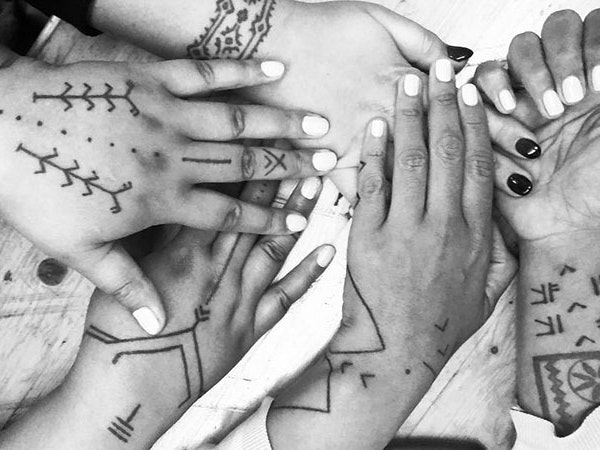
Who said tattooing is ‘men’s’ work anyway? Watch a panel discussion from Te Papa inspired by the stories of women mark makers who are revitalising female tattooing in Aotearoa, Fiji, Papua New Guinea, and Sāmoa.
Te Papa is part of WanBel: a PNG Collective Global Exhibition. June 2025 to September 2026