







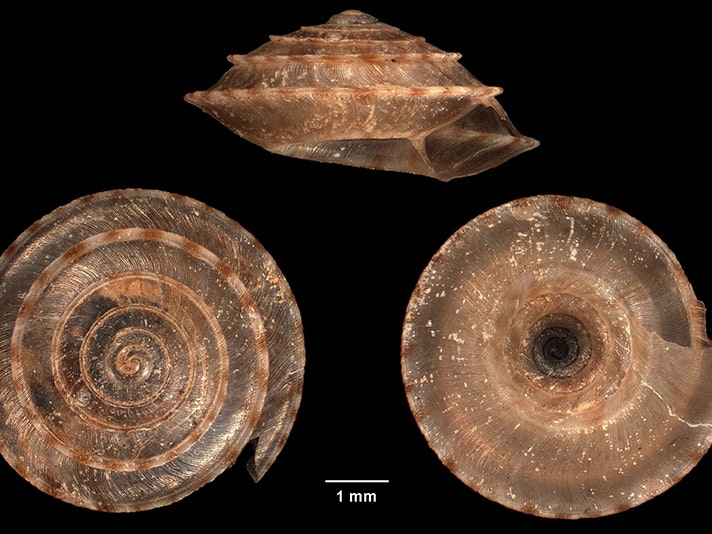
Long-lost relatives: Joining the dots in snail superfamilies
A new DNA study by our researchers Rodrigo Salvador and Lara Shepherd has revealed an unexpected land snail family across the Pacific.
Free museum entry for New Zealanders and people living in New Zealand
Open every day 10am-6pm
(except Christmas Day)
Free museum entry for New Zealanders and people living in New Zealand
Te Papa researcher: Kerry Walton
Aotearoa New Zealand has almost 2,000 living terrestrial and freshwater mollusc species – most of which are found nowhere else on earth. Numerous factors are working against our land-snails and slugs: a changing climate, adventive species as competitors or predators, and habitat degradation and loss.
Te Papa supports or leads a range of projects to better understand the diversity, evolutionary origins, biosecurity implications, and conservation requirements of terrestrial molluscs in Aotearoa.
Te Papa researchers are presently contributing to palaeogenetic research into the diversity of endangered species of the large land-snail genera Maoristylus, Paryphanta, and Powelliphanta. These projects are being undertaken in partnership with iwi leaders and researchers from the University of Otago, Massey University and the Department of Conservation.
Main collaborators: Fred Brook, Nelson (indep.); Hamish Spencer, Tania King & Martyn Kennedy, (University of Otago), Simon Hills (Massey University), Sheridan Waitai (Ngati Kuri iwi)
Funding: University of Otago; Department of Conservation
Representative publications:
Walker, K., Walton, K., Edwards, E., Hitchmough, R., Payton, I., Barker, G. M., & Michel, P. (2024). Conservation status of New Zealand indigenous terrestrial Gastropoda (slugs and snails) Part 3. Rhytididae (carnivorous snails), 2022. New Zealand Threat Classification Series 42. Department of Conservation, Wellington
Three medium-sized carnivorous land-snails from the Abel Tasman National Park. Photo by Kerry Walton. Te Papa
Shell of the giant carnivorous land-snail Powelliphanta superba, Anaweka River catchment, Tasman, Aotearoa New Zealand. Photo by Kerry Walton
A new DNA study by our researchers Rodrigo Salvador and Lara Shepherd has revealed an unexpected land snail family across the Pacific.
A handy introduction to the unique shells of Aotearoa New Zealand, for the backyard, bach and backpack.

Kerry Walton and Bruce Marshal discuss ‘Native Shells of Aotearoa’ with Te Papa Press.