







About our Natural History research
Find out about our Natural History research areas and who we are.
Free museum entry for New Zealanders and people living in New Zealand
Open every day 10am-6pm
(except Christmas Day)
Free museum entry for New Zealanders and people living in New Zealand
Te Papa researchers: Kerry Walton and Bruce Marshall (Research Associate)
Applying ancient DNA techniques to global historical abalone samples from Te Papa's collections, we are reconstructing the global abalone family tree.
Main collaborators: Hamish Spencer, Nic Rawlence and others (University of Otago); Philippe Bouchet and Nico Puillandre (MNHN, Paris)
Funding: University of Otago
Representative publications
Walton, K., Scarsbrook, L., Mitchell, K. J., Verry, A. J. F., Marshall, B. A., Rawlence, N. J., & Spencer, H. G. (2023). Application of palaeogenetic techniques to historic mollusc shells reveals phylogeographic structure in a New Zealand abalone. Molecular Ecology Resources, 23, 118–130.
Link
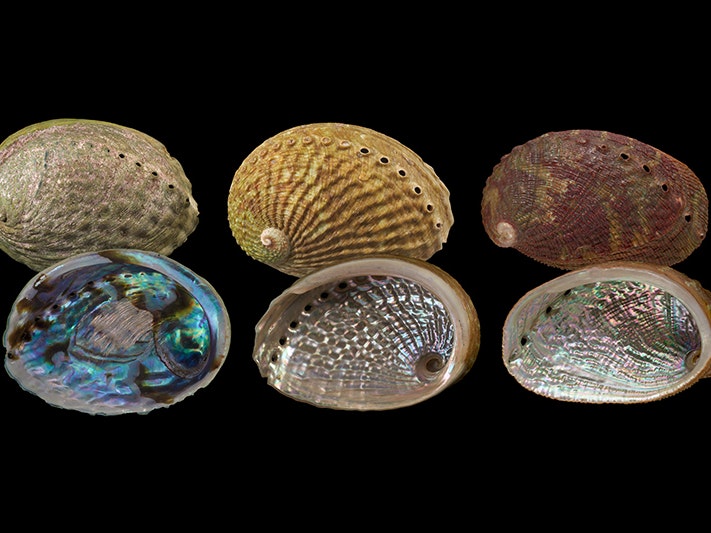
Composite photo of black-foot (left), yellow-foot (centre), and virgin pāua (right). Photos by Jean-Claude Stahl, Melissa Irving, Kerry Walton. Te Papa CC BY-SA
Find out about our Natural History research areas and who we are.
The discovery of the Manawatāwhi pāua, unique to the Three Kings Islands, highlights the need to build taxonomic expertise to speed up work to describe thousands of as-yet-unnamed species. Authors Kerry Walton, Curator Invertebrates, Te Papa, Hamish G Spencer, Sesquicentennial Distinguished Professor of Zoology, University of Otago, and Nic Rawlence, Associate Professor in Ancient DNA, University of Otago discuss the ramifications of the new find.

As part of an internship exploring how blackfoot pāua are represented in Te Papa, Sara Joyce Macdonald highlights a few collection items showing the varied uses of pāua and the importance of this unique taonga to Aotearoa New Zealand.