





Queer ordinariness and representation in sport
Queer people in Aotearoa have always been part of everyday life – working, socializing, raising families, and taking part in the same pastimes as everyone else. Sport is one of those shared spaces.
From local clubs to international competitions, Queer athletes and supporters have long been part of Aotearoa’s sporting culture, even when they were invisible.
This ordinary presence is seen through 3 familiar parts of New Zealand life: mucking around in the water, laughing at rural comedy like the Topp Twins, and of course rugby.
Mucking around in and around water has long been part of life in Aotearoa, as seen in this joyful image in the Alexander Turnbull Library.


Robert Gant, Men bathing in a river, between 1897 and 1889. Photo by Robert Gant. Alexander Turnbull Library ( PA1-q-962-38-1)
Knowing photographer Robert Gant’s interest in close male friendships, the image invites us to think about how intimacy and affection between men could exist in everyday spaces. Beneath the carefree smiles and bare skin, quiet possibilities of desire and connection ripple just below the surface.
The Topp Twins – Dames Jools and Lynda Topp – have been entertainers; fearless activists for Māori rights, peace, and Queer visibility; and exemplars of real, ordinary kiwis for decades. Two of their most iconic characters are Camp Mother & Camp Leader, here immortalised as knitted dolls.
Camp Mother – bossy, bold, and decked out in pink velour – ruled Happy Valley Camping Ground with handbag and wit. Camp Leader – cheerful, woolly, and forever in jelly sandals – followed Camp Mother with earnest enthusiasm.
These dolls capture the Topp Twins’ genius for mixing rural Kiwi humour with radical protest, whether at anti-nuclear rallies or Pride marches. Beneath their cheeky charm lay decades of courage that helped shift Aotearoa’s attitudes toward gender, sexuality, and equality.

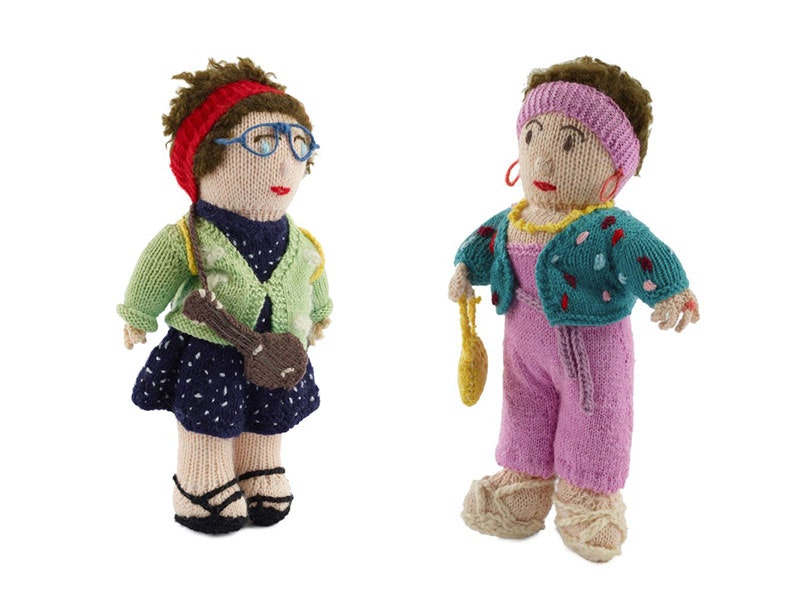
Camp Leader and Camp Mother knitted dolls, about 1999, New Zealand, maker unknown. Gift of Lynda and Jools Topp, 2000. Te Papa (GH007984 and GH007985)
New Zealand’s first gay rugby game was played in 1998 between the Krazy Knights from Wellington and the Ponsonby Heroes (also known as the Rainbow Heroes) from Auckland. The teams included players from all walks of life – including founder Dean Knight and future Minister Grant Robertson, who met his partner Alf Kaiwai through the sport.
This signed ball commemorates that historic game.
Reflecting on the signed rugby ball from the game invites us to think more broadly about Queer representation in sport, particularly for men. What makes the 1998 game significant is not simply that it was the first interprovincial Queer rugby match, but how ordinary it was. Thousands of rugby games are played each year across Aotearoa; this one mattered because of the people involved. It represents part of a slow and uneven process of social change, rather than a single dramatic moment.

'Krazy Knights v Rainbow Heroes' rugby ball, 1998, India, by Gilbert Rugby. Gift of Alan Bracegirdle, 2020. © The copyright holder. We are actively seeking the copyright holder. Contact copyright@tepapa.govt.nz if you can help. Te Papa (GH025532)
The New Zealand Falcons, founded in 2013, carry forward the legacy of the Krazy Knights and Rainbow Heroes and compete in national and international gay rugby events.
Teams like the Falcons now compete internationally, linking Aotearoa’s Queer rugby communities with a wider global network of players.
This poi was used by spectators during the 2021 Rugby World Cup, especially to celebrate the New Zealand women's national rugby union team 2022 victory. The Black Ferns are known for their strong ties with women and Rainbow Communities, and include many Queer players, offering vital visibility and representation within major mainstream sports.

Poi, Rugby World Cup 2021, 2022, New Zealand, maker unknown. Gift of Grace Hutton, 2023. © The copyright holder. We are actively seeking the copyright holder. Contact copyright@tepapa.govt.nz if you can help. Te Papa (GH026457/1-2)
Queer visibility in sport has been unevenly distributed. While openly Queer men remain rare in many professional codes, women’s sport has often offered greater space for Queer visibility.
The Amazons were a Wellington softball club (1977–2011) where lesbian women found community and support. Part of New Zealand’s gay rights movement, they brought visibility to women’s sports when lesbians were rarely spoken about publicly. Over time, growing acceptance meant the club’s safe-space role became less necessary.

Player's shirt, Amazon Softball Club uniform, Circa 2000, New Zealand, by Anna Louise Schoolwear. Gift of the Amazon Softball Club Inc., 2012. Te Papa (GH017600)
Queer participation in sport has also taken place on an international stage. The Gay Games (first held in 1982) and the World Outgames (2006–2017) were international sporting and cultural events created so LGBTQ+ athletes could compete openly.
New Zealanders have taken part in many of these competitions. An Aotearoa team attended the 1990 Gay Games in Vancouver, and Wellington later hosted the 2011 Asia-Pacific Outgames.

Gay Games III badge, 1990, Canada, by Manx Press. Gift of Tim Walker, 1996. © The copyright holder. We are actively seeking the copyright holder. Contact copyright@tepapa.govt.nz if you can help. Te Papa (GH004672)
Team Auckland badge, 1990, New Zealand, maker unknown. Gift of Tim Walker, 1996. © The copyright holder. We are actively seeking the copyright holder. Contact copyright@tepapa.govt.nz if you can help. Te Papa (GH004668)
These taonga are held in museums because they help tell important stories. Their importance does not come from being rare or extraordinary. Instead, they matter because they show ordinary life.
Mucking around in the water, laughing at satire, and playing sport are all familiar parts of life in Aotearoa. Queer people have always been part of these everyday activities.
Sport can bring people together across differences of class, ethnicity, and gender. It creates moments of connection, where Queer people are neither ignored nor treated as unusual.
As someone with little personal interest in rugby, and whose childhood experiences of sport were shaped by bullying, I initially felt no strong connection to this taonga. Connection emerged not through sporting achievement, but through stories of belonging, intimacy, and ordinariness.
Even now, Queer representation is missing at the highest levels of professional sports, and role models are few, particularly among men’s teams. Violence against Queer athletes – in person or online – keeps many from coming out. These taonga show Queer people have always been active in Aotearoa. They remind us that Queer communities have long been part of everyday life.
Seen alongside contemporary media, taonga associated with Queer sport speaks to past invisibility, but to ongoing absences – and to the quiet, ordinary ways Queer people have always been present within national pastimes.
Note on language: This essay uses ‘Queer’ and ‘Rainbow Communities’ as inclusive umbrella terms for a range of sexual orientations, gender identities, and expressions. These terms are capitalised to recognise their use as collective and political identifiers. They are culturally and historically specific, reflecting contemporary Anglophone usage, and do not fully encompass the distinct meanings of terms such as Takatāpui, MVPFAFF, or other Indigenous and diasporic frameworks.
Scott Pilkington (he/any) is a Tāmaki Makaurau-based researcher and creative practitioner working across Queer history, museum practice, and material culture. His work explores what material culture can tell us about Aotearoa’s past and present, particularly where stories have been overlooked or obscured. He is currently exploring Aotearoa Queer stories through taonga held in museum collections.