From hard-won political campaigns to the everyday act of walking proudly down the street, queer communities in Aotearoa have embodied pride in a myriad of ways throughout our history. Historian Will Hansen explores.
A history of pride in Aotearoa New Zealand
Will Hansen
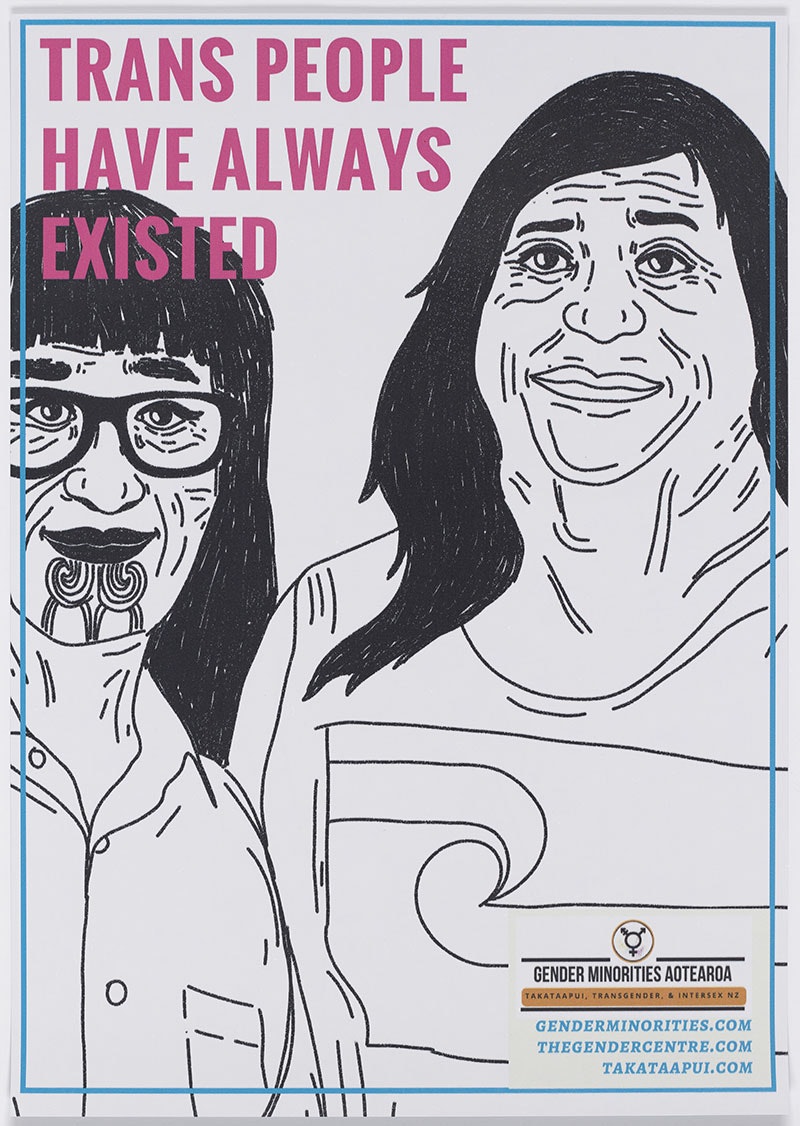
Progress Pride badge, 2020, New Zealand, by Wellington City Libraries, Daniel Quasar. Gift of Gareth Watkins, 2022. Te Papa (GH026169)
Long histories
Before colonisation, takatāpui– Māori of diverse genders, sexualities, and sex characteristics – were accepted by their communities. Scholars like Ngāhuia Te Awekōtuku have demonstrated that takatāpui are present in mōteatea, pūrākau, whakataukī, and carvings, as well as in early European records.[1]
Colonisation brought attitudes and laws that aimed to suppress gender and sexual diversity, a mechanism of colonisation and disrupting te ao Māori.
Queer people persisted through oppression. We see glimmers of their lives in the archives.
Men embracing and kissing. Gant, Robert, 1854?-1936 :Photograph albums. Ref: PA1-q-962-61. Alexander Turnbull Library, Wellington, New Zealand. /records/22563352
In an 1880s photobook from small-town Wairarapa, groups of men wearing dresses and bonnets embraced in front of Robert Gant’s camera.[2]
In 1929 the Sun newspaper described how trans women Hune Nikora Haora was supported by her mother, friends, and employer while facing a dehumanising court case.[3]
After World War II , increasing numbers of New Zealanders moving to cities helped urban queer communities bloom.[4]
Gathering in pubs and shared houses, on the docks and on the streets, a common culture and language emerged. In these growing communities, people of a variety of genders and sexualities referred to themselves as ‘kamp,’ using it in much the same way as many people use ‘queer’ today.
Formal gay organisations were even established, with the first being Wellington’s Dorian Society, in 1962.
By the late 1960s, coffee bars run by trans women – most famously Carmen Rupe and Chrissy Witoko – reflected how queer communities were increasingly taking up public space. Carmen and Chrissy were not quiet about being trans. They refused to be invisible and isolated, instead creating places that became community hubs for queer people.
‘Let’s Start Gay Liberation!’
Ngāhuia Te Awekōtuku was proudly kamp. She turned heads walking hand-in-hand with her lover around Auckland University campus, where she studied law.
In 1971 she gained notoriety as a feminist activist, declaring on television during a women’s liberation protest that she was a ‘sapphic woman.’[5]
Eager to learn more about the American gay liberation and indigenous Red Power movements, in early 1972 Ngāhuia applied for, and won, a grant to study in the United States.
As her leaving date approached, however, she still had not received her visa. On 15 March Ngāhuia asked the American Consulate for clarity and was told her visa was stalled on the grounds of her ‘sexual deviance.’
Infuriated, she stormed back to campus – in time to speak at the university’s lunchtime open microphone. She gave a rousing speech challenging her fellow students to be open about their homosexuality: ‘who out there is crazy enough to join me – and let’s start gay liberation!’[6]
At a series of meetings following Ngāhuia’s call to action, the Auckland Gay Liberation Front was born.
They decided to use the word ‘gay’ to describe their collective of minorities. This included those who were ‘bisexual or non-sexual’ and those who ‘overtly reject sexist gender programming,’ such as ‘transvestites and transsexuals,’ ‘drag queens and heavy butch dykes.’[7]
The Auckland Gay Liberation Front’s manifesto laid out how their oppression was rooted in sexism. Sexism was embedded in society, so law reform alone could not bring freedom for gay people. Only through a total societal revolution could liberation be achieved![8]
Shame had kept people closeted and isolated, so gay liberationists encouraged queer people to feel pride in themselves and their sexuality.
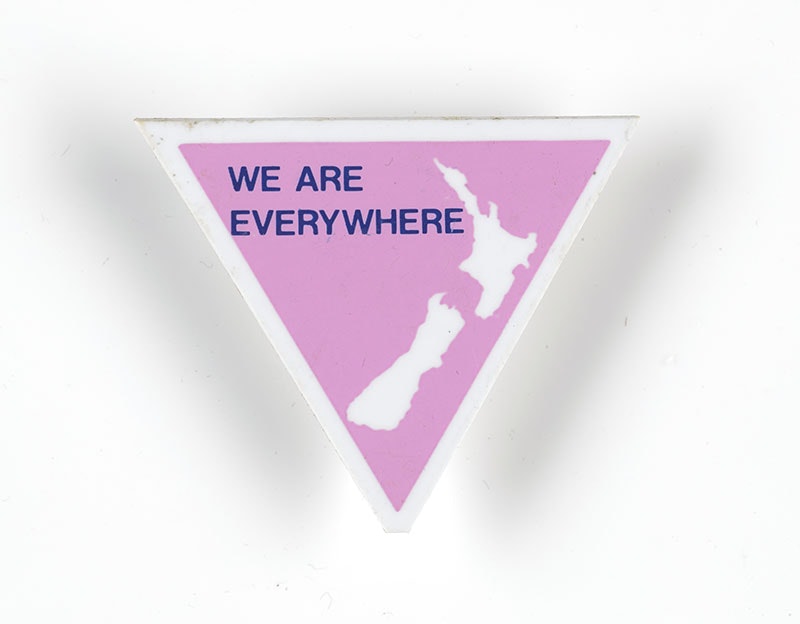
We Are Everywhere badge, about 1979, by National Gay Rights Coalition, New Zealand. Gift of Lesbian and Gay Archives of New Zealand, 2017 (GH025206)
The Front knew undoing these feelings of shame was key to mobilising greater numbers to come out and join their movement, so they organised consciousness-raising sessions. Participants unpacked their individual experiences with comrades, and were helped to understand their collective oppression – and their collective power.
The Front’s many protest actions were provocative and playful. Their first action, ‘Gay Day,’ was held on 11 April 1972 in Albert Park. Gathering under a statue of Queen Victoria, activists held placards reading ‘Will Victorian morality ever die?’, while others performed a guerrilla theatre piece. Their skit explored the violence queer people faced from police and gay-bashers, and drew parallels with how anti-Vietnam War protesters were also violently suppressed by the police.
A news team was invited to film the protest and interview participants. This was a brave move because it meant coming out in a highly visible way.[9]
Rainbow Flag painting, 2012, United States, by Gilbert Baker. Gift of Gareth Watkins and Roger Smith, 2021. Te Papa (GH026076)
The First Gay Pride Week
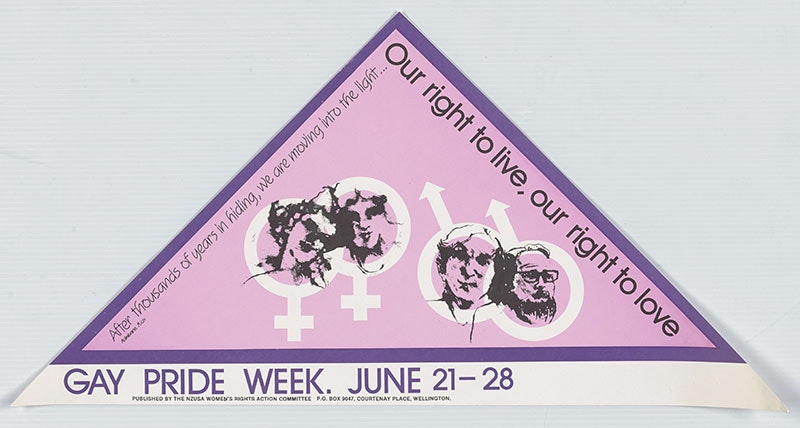
The first ‘Gay Pride Week’ in Aotearoa was held in June 1973, organised by the Auckland Gay Liberation Front and its new spinoff group, University Gay Liberation. Gay Pride Week activities included various seminars on topics such as socialism and lesbianism, daily guerrilla theatre performances, and ended with a protest march and social gathering.
Gay Pride Week was planned for the 25-29th June, chosen for both the birthday of the Auckland Gay Liberation Front, and to commemorate the Stonewall Riots in New York 4 years earlier.
The Stonewall Riots were sparked after a police raided a popular gay bar. Patrons fought back and rioted in the streets for days afterward.[10]
The riots are often heralded as the beginning of the gay liberation movement. While that is not strictly true, they were certainly a massive boost to the movement and its visibility.[11]
It was because of the riots that many people first heard about the new gay liberation movement – including in Aotearoa.
In their Gay Pride Week programme, the Auckland Gay Liberation Front declared: ‘Today, for the first time, gay people are discovering that gay is proud. That is the first step towards liberation. And in the course of this struggle, we will aim at the heart of the sex-repressive institutions of our society. For what is needed is not to adapt homosexuals to their environment – or heterosexuals either, for that matter – but to completely overthrow the sexually repressive institutions of our society.’[12]
Gay Pride Week poster, 1981, New Zealand, by New Zealand University Students Association Women's Rights Action Committee. Gift of Lesbian and Gay Archives of New Zealand, 2017. Te Papa (GH025210)
Pride flourishes
Gay Pride Weeks were held annually from 1973 onwards, and the idea was quickly adopted by the Gay Liberation Fronts that had been established in other towns too.
Pride was not, however, only confined to these more organised events!
Carmen Rupe, one of Aotearoa’s most famous and most significant trans women, was brimming with pride. She was confident in her identity, loved glamour and publicity, and her larger-than-life persona inspired confidence in so many. In 1977 Carmen even ran for Mayor of Wellington. This was an act of pride, certainly, and an attempt to jostle the status quo in Carmen’s characteristically glamorous and humorous way.
Pride is also undoubtedly on display in the beautiful collages made by Carmen’s friend and fellow Pōneke-based trans matriarch, Chrissy Witoko. Her pride in her friends, her community, and the coffee lounges and bars she managed and frequented shines brightly in these lovingly composed artworks, which span from the 1960s through the 1990s.
Whakawāhine (Māori trans women) like Carmen and Chrissy were significant figures in local queer communities. They created spaces that felt like home for those so frequently cast out, and demonstrating what it meant to live life with your head held high.
Chrissy Witoko, Collage, Circa 1975, Wellington. Gift of the Witoko family in memory of Chrissy Witoko, 2012. Te Papa (GH015982)
Chrissy Witoko, Collage, circa 1980, Wellington. Gift of the Witoko family in memory of Chrissy Witoko, 2012. Te Papa (GH015983)
During the struggle to decriminalise homosexuality, determined queer activists faced intense hostility from anti-gay campaigners.
The backlash was swift when Member of Parliament Fran Wilde introduced her Bill to decriminalise homosexuality on 8 March 1985. Only a day later the Salvation Army and Coalition for Concerned Citizens launched their anti-reform campaign.
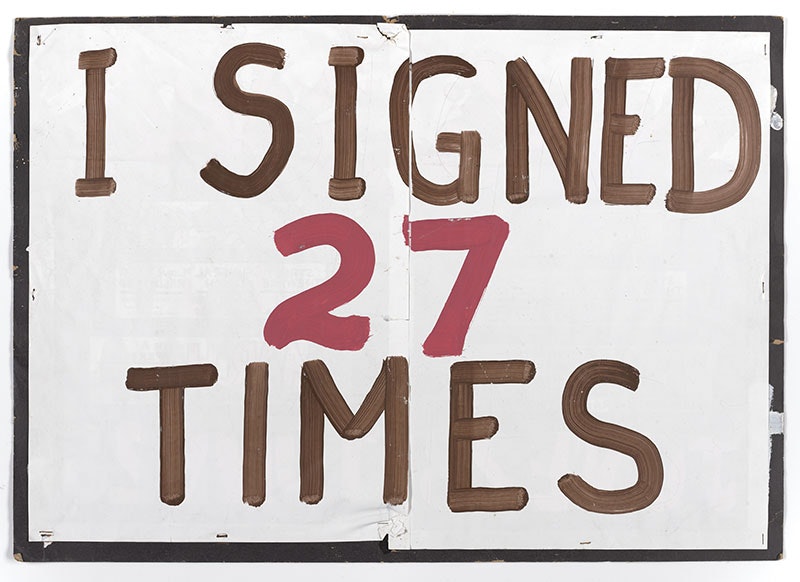
The anti-reform groups’ key strategy was gathering a petition against the bill, which they believed would be the largest in history. It quickly became clear, however, that dubious tactics were being used to boost numbers, including pressuring children to sign, duplicating and faking signatures. Even Mickey Mouse purportedly signed it! The petition was rejected, though heated opposition did not die.[13]
‘I signed 27 times’ placard, September 1985, by Hugh Young, New Zealand. Gift of Hugh Young, 2016. Te Papa (GH024821)
In March 1986, Des Smith organised a Lesbian & Gay Fair at Newtown school in Wellington. It was a fun occasion amidst the campaign chaos. Friends and family gathered, local queer community groups informed visitors their work, stallholders sold homemade wares, and visitors could play games such as ‘pin the wooden leg on Norm Jones’ (a leader of the anti-reform campaign).[14] Promoted as ‘a fair for a fair law’, it raised $2300 for the Wellington Gay Task Force’s work agitating for homosexual law reform.[15]
The Lesbian & Gay Fair continues annually in March today, having since morphed into Wellington Pride Festival. This makes Wellington Pride Festival the country’s oldest living ‘Pride’ event!
The 1980s brought many battles for queer communities, but the most devastating was undoubtedly the AIDS crisis. Since people with AIDS were overwhelmingly queer men, they faced not only a life-threatening illness with no known cure, but also intense stigma and woefully inadequate government support. Some medical professionals refused to treat people with AIDS, some families did not allow bereaved lovers and friends to attend funerals, and hostile messages were frequently shared by the media.
Facing these horrors, queer communities rallied together. They got organised, forming support groups and care networks, crafting educational campaigns and lobbying for more funding and research. They created groups like the People with AIDS Collective, Body Positive, the AIDS Support Network (which became the New Zealand AIDS Foundation), Te Roopu Tautoko Trust, and many more.
In early 1989, the People with AIDS Collective launched the NAMES Project AIDS Memorial Quilt. Inspired by the original San Francisco quilt project, participants created panel measuring three by 6 feet – the approximate size of a grave – to mourn and honour their deceased loved ones. The individual panels were then stitched together, creating a large quilt to serve as a graphic reminder of the scale of the crisis.
People with AIDS Collective spokesperson Daniel Fielding made the first panel, dedicated to his late partner and fellow activist Peter Cuthbert who died on 31 October 1988.[16]
Daniel saw the Project as a means of ensuring that ‘those who have fought so bravely are not forgotten.’[17] Panels from the Quilt were displayed in public parks, halls and schools, educating people about the scale of the pandemic and humanising those impacted.
Another innovative and powerful response to AIDS came from Rex Halliday, the Prevention Coordinator of the New Zealand AIDS Foundation. Rex knew that having a strong sense of community created higher self-esteem, which in turn made someone more likely to commit to having safe sex.
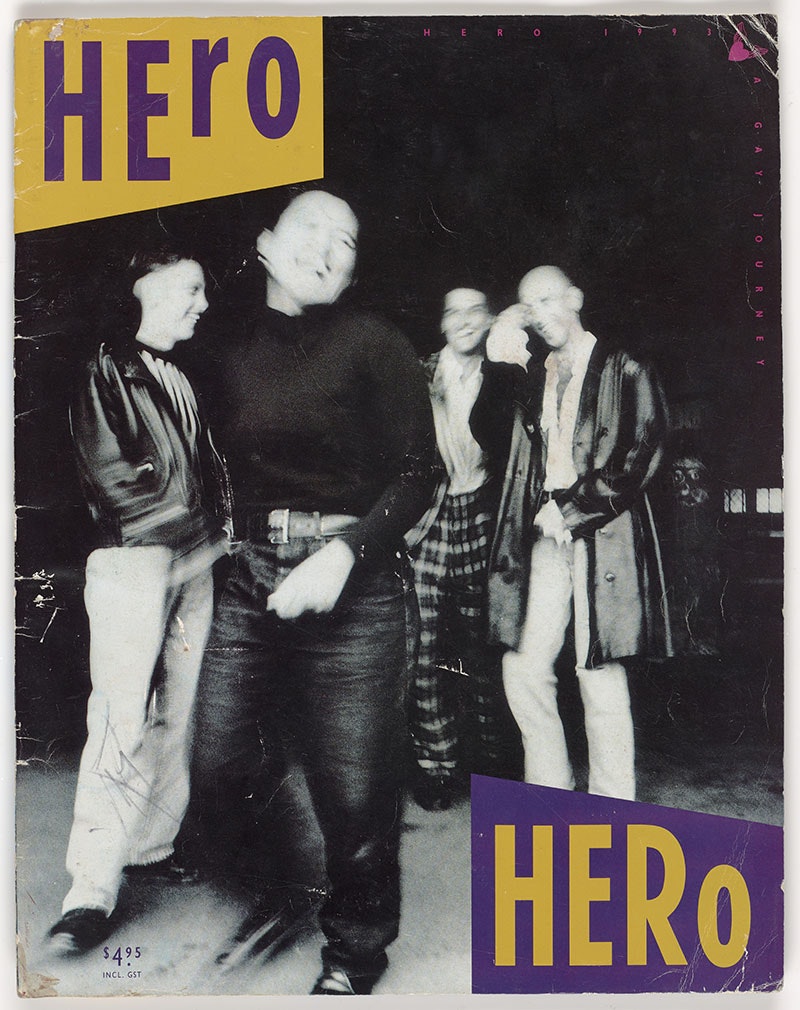
In 1991 Rex and the Foundation created HERO, a massive dance party in Auckland that would uplift and celebrate local queer communities. The theme of ‘hero’ was because Rex believed that queer people were ‘immensely heroic’ for surviving ‘in a society that tells you that the deepest part of you, the part that loves, is depraved and immoral.’[18]
Hero magazine, 1993, The HERO Project Limited, New Zealand. Gift of Te Herekiekie Herewini, 2011. Te Papa (CA001013/001/0002)
HERO soon evolved into a larger, annual festival that produced a newspaper. From 1994 until 2001 HERO also included an energetic street parade, and in 2000 introduced the Big Gay Out day festival which continues today. Other cities were inspired. Wellington created an annual festival named Devotion, and Christchurch created the Freedom festival. These were ‘pride’ events in everything but name and laid the blueprint for the pride celebrations that followed.
Hero was well attended, but it was burdened by financial issues and ended in 2001. It wasn’t until 2013 that Auckland had their next parade march – but not without difficulties.
In a global trend known as ‘pinkwashing’, corporations and various government institutions increasingly showed up at pride events. Replete with rainbow stickers emblazoned with company logos, these organisations sought the glow of being able to proclaim themselves as ‘diverse and inclusive,’ despite not necessarily implementing pro-queer policies to match.[19]
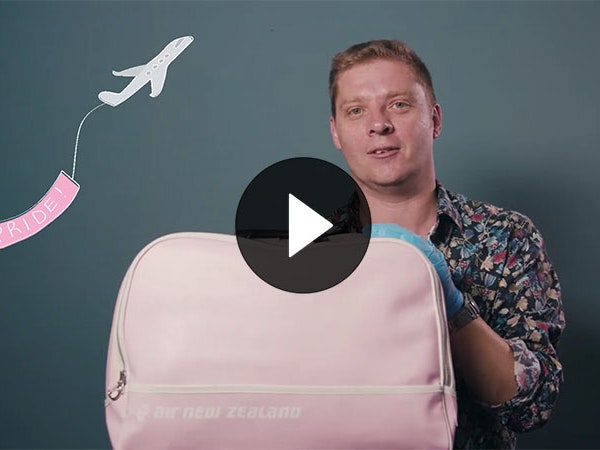
Air New Zealand flight bag, 2008, New Zealand, by Air New Zealand Ltd. Purchased 2014. Te Papa (GH024317)
In 2014, Queers Against Israeli Apartheid crashed the Auckland Pride Parade to protest the inclusion of the Israeli Embassy, arguing that they were using pinkwashing to cover up their violent occupation of Palestine.[20] The following year, another crew halted the parade, this time in opposition to the police contingent.
Poster, 'Auckland pride parade', 2013, New Zealand, by Auckland Pride Festival Trust. Gift of Gareth Watkins, 2013. Te Papa (CA001145/001/0001)
Initially calling themselves No Pride in Prisons (NPIP), now named People Against Prisons Aotearoa, they saw police participation as using pinkwashing to divert from the fact that ‘queer, Māori and Pasifika communities are disproportionately harassed and targeted by the police.’[21]
NPIP gained significant momentum. In 2016, 300 NPIP demonstrators blockaded the Auckland Pride Parade. Chanting ‘police are violent, we won’t be silent,’ they protested against new double-bunking policies in prisons, which had left vulnerable inmates at a higher risk of assault. NPIP had been in contact with 2 trans women in the 4 months prior who had both been raped while in custody.[22]
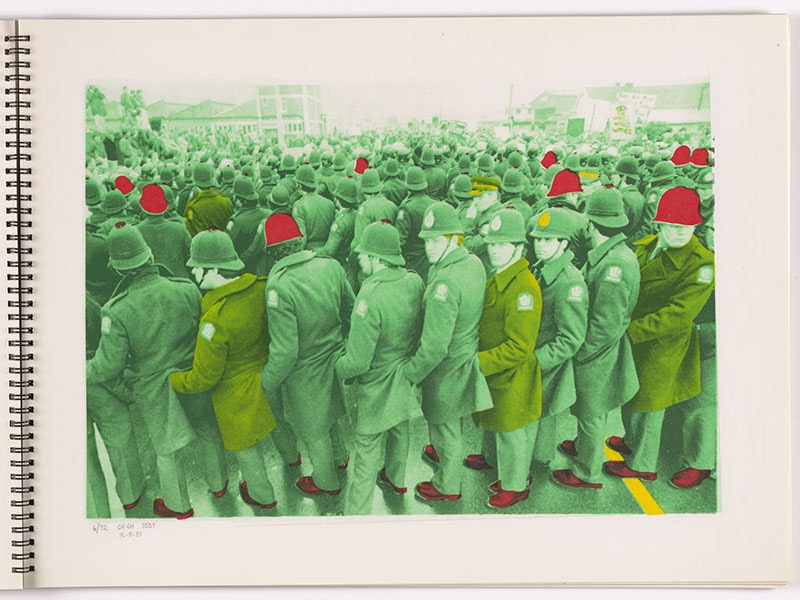
After continued NPIP advocacy and extensive community consultation, the Auckland Pride Board requested police abandon their uniforms when marching in the 2019 parade as a gesture of solidarity. The decision caused an extraordinary stir. The Police, New Zealand Defence Force, and several corporate sponsors pulled out of the parade.
Rainbow target shirt, 2019, by Auckland Pride Board, Michael Lett. Gifted by Ta'i Paitai, 2021. Te Papa (GH018539)
In response to this loss of financial support, the Board decided to host ‘#OurMarch’. Community-led, the march reflected the original roots of protest; and, like the very first pride march of 1972, it began in Albert Park under the statue of Queen Victoria. The Board’s chair, Cissy Rock, explained that ‘#ourmarch is about making Auckland Pride a place for all of us to be visible, involved and heard...people [are] at the heart of what we do.’[23]
It was a success, attracting over 3000 community members of all stripes. One Filipino Aucklander held a sign that summarised the kaupapaof the march: ‘If your gay pride does not compel you to protest, what purpose does it serve?’[24]
While this article’s small snapshot has focused largely on Tāmaki Makaurau, throughout the motu pride is demonstrated every day.
Aotearoa’s smaller towns, pride has been embodied in the collectives of people who proved that queer people truly do exist everywhere. From short-lived groups like Gay Liberation Rotorua (founded in 1973) to New Zealand’s oldest existing queer organisation, the Manawatu Lesbian and Gay Rights Association (established in 1977), countless hours have been poured into creating gathering spaces and lobbying for change.
More recently, pride has looked like the people of Gisborne defending a drag queen performance from anti-queer protesters in March 2024, and the Pride Wairau crew out-singing counter-protesters at their pride rally in June 2025.[25] Pride is present in peoples’ continued determination to ensure that Pride events remain places of protest and solidarity, as in the 2024 Wellington Pride Festival hīkoi where participants marched under 3 pillars: Mana Takatāpui, Toitū Te Tiriti, and Free Palestine.[26]
With a rise in violence against queer communities, we have also seen profound displays of resilience and solidarity, as queer people stand together against those who would scare us into silence and isolation. Pride and protest are one in the same. And, in 2026, pride is as important as ever.
Solidarity forever placard, created by Will Hansen as part of the transgender bloc of the Waitangi Solidarity Hīkoi, 2024. Photo supplied by Will Hansen.
[1] Ngāhuia Te Awekōtuku, ‘He Reka Anō - Same-Sex Lust and Loving in the Ancient Māori World’, in Outlines: Lesbian & Gay Histories of Aotearoa, ed. Alison J. Laurie and Linda Evans, with Lesbian & Gay Archives of New Zealand (Lesbian & Gay Archives of New Zealand, 2005).
[2] Chris Brickell, Manly Affections: The Photographs of Robert Gant (Genre Books, 2012).
[3] ‘Masquerading as Woman’, Sun (Auckland), 4 May 1929, 1.
[4] Chris Brickell, Mates and Lovers: A History of Gay New Zealand (Random House, 2008).
[5] ‘Ngahuia Te Awekotuku’, NZHistory, 2018, https://nzhistory.govt.nz/media/video/ngahuia-te-awekotuku.
[6] Claire Gummer, ‘30 Years of Gay Liberation (Part 2)’, GayNZ.Com, 1 December 2002, https://www.pridenz.com/gaynz/57.html.
[7] ‘Gay Is Proud’, Gay Lib News, November 1972, 1; Sandy Gauntlett to Nigeleena von Camp, c 1976, MS-Papers-0492, Kawe Mahara; Sha, ‘Conference Speech’, Gay Liberator, October 1973; Sandy Gauntlett, ‘Defiance’, Defiance, November 1973.
[8] Nigel Baumber, ‘Gay Liberation: A Movement for Social Change – Auckland 1972-1975’ (Masters thesis, University of Auckland, 1978), 103.
[10] Matthew Riemer and Leighton Brown, We Are Everywhere: Protest, Power, and Pride in the History of Queer Liberation (Ten Speed Press, 2019), 114–16.
[11] Elizabeth A. Armstrong and Suzanna M. Crage, ‘Movements and Memory: The Making of the Stonewall Myth’, American Sociological Review 71, no. 5 (2006): 724–51.
[12] ‘‘Come Out! Gay Is Proud!’ Gay Pride Week Programme’, Gay Lib News, July 1973, 4.
[13] Laurie D. Guy, Worlds in Collision: The Gay Debate in New Zealand, 1960-1986 (Victoria University Press, 2002), 208–13.
[17] ‘NAMES Project Launched in New Zealand’, OUT!, March 1989, 9.
[18] Nicola Legat, ‘Hay Fever’, Metro, June 1994, 95.
[19] Danielle Street, ‘Queer Activists Vandalised a ‘Gay’ ATM in Auckland’, Vice, 24 February 2015, https://www.vice.com/en_nz/article/yvqyzk/queer-activists-vandalised-a-gay-atm-in-auckland; Aych McArdle and Tess McClure, ‘Auckland Pride Parade and the Hypocrisy of Big Corporate’, Vice, 23 February 2018, https://www.vice.com/en_nz/article/qvee5w/auckland-pride-parade-and-the-hypocrisy-of-big-corporate; Maxine Jacobs, ‘Pride Parade: More Sponsors Pull Their Support’, Radio New Zealand, 21 November 2018, https://www.radionz.co.nz/news/national/376489/pride-parade-more-sponsors-pull-their-support; ‘Pride Parade Sponsors ‘blackmailing’ Gay Community - Rākete’, with Emilie Rākete, Radio New Zealand, 23 November 2018, https://www.radionz.co.nz/national/programmes/morningreport/audio/2018672476/pride-parade-sponsors-blackmailing-gay-community-rakete.
[20] Queers Against Israeli Apartheid Aotearoa, ‘There’s Pride in Resistance, Not Apartheid’, GayNZ.Com, 26 February 2014, https://www.pridenz.com/gaynz/14689.html.
[21] No Pride in Prisons, ‘Transgender Woman’s Arm Broken by Police at Pride Parade’, Scoop, 22 February 2015, https://www.scoop.co.nz/stories/print.html?path=AK1502/S00523/transgender-womans-arm-broken-by-police-at-pride-parade.htm.
[22] Scott Yeoman, ‘Protesters Bring Pride Parade to a Halt - NZ Herald’, New Zealand Herald, 20 February 2016, https://www.nzherald.co.nz/nz/news/article.cfm?c_id=1&objectid=11592972.
[23] ‘Auckland Pride Announce Details for #OURMARCH’, Auckland Pride, 23 January 2019, https://web.archive.org/web/20210212043635/https://aucklandpride.org.nz/ourmarch-announcement/.
[24] Anthony Byrt, ‘What Really Happened to the Pride Parade?’, Metro, 30 May 2019, https://www.metromag.co.nz/society/society-politics/auckland-pride-parade-police-our-march-metro.
[26]Pride Hīkoi (2024), Wellington, 9 March 2024, PrideNZ.com, https://www.pridenz.com/pride_hikoi_2024.html.
Will Hansen (he/him) is an historian, community archivist, library assistant and zine-maker based in Pōneke Wellington. He completed his Masters thesis in 2020, titled ‘“Every Bloody Right To Be Here”: Trans Resistance in Aotearoa New Zealand, 1967 - 1989’, which used oral histories to explore the various politics of resistance practiced by trans elders. As a trustee of Te Pūranga Takatāpui o Aotearoa/Lesbian and Gay Archives of New Zealand, he is passionate about preserving and sharing Aotearoa’s queer histories, connecting queer kiwis to their past. In 2019 he was a co-leader of Te Papa’s Trans Past, Trans Present: The Making Trans Histories Project.
The world is full of queer objects. But what exactly makes an object queer? Can a telephone be queer? Chris Brickell, co-editor of the book Queer Objects (OUP, 2019), which features everything from a teapot to a sex toy, talks us through what makes an object queer with taonga from Te Papa’s collection.
Trans people from their teens to their 70s were asked to identify objects of personal importance and to share the objects’ stories. What emerged was a quirky collection that is a testament to the diversity of trans experiences, and which disrupts established (and cis-written) narratives about trans lives.
In 1998 Neil Anderson and Michael Eyes gifted a collection of over 20 queer-themed T-shirts to Te Papa from the 1980s and 1990s. Neil Anderson recalls his time as a queer activist before the Human Rights Act of 1993, which made it illegal to discriminate against people on the basis of their sexual orientation.