





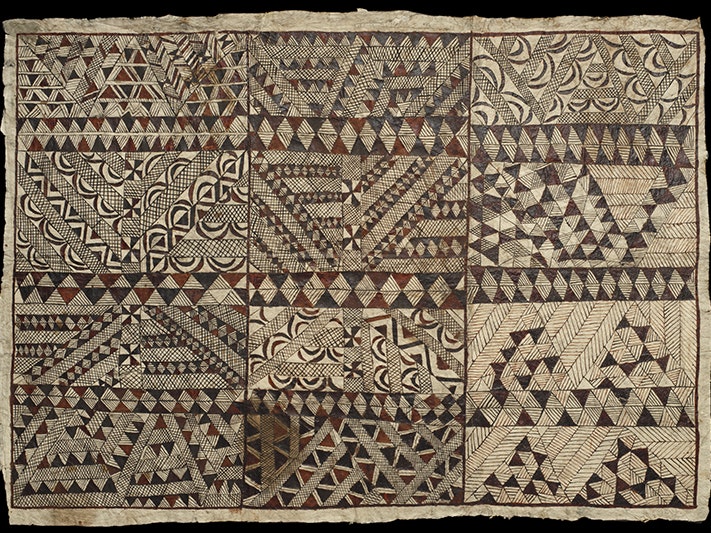
View the masi (tapa cloth) from Fiji in our collections
Fijian masi (tapa) has customarily been used for ceremonial occasions such as weddings or the conferring of a chiefly title. Explore tapa and tapa related objects from Fiji.
Free museum entry for New Zealanders and people living in New Zealand
Open every day 10am-6pm
(except Christmas Day)
Free museum entry for New Zealanders and people living in New Zealand
Watch Fijian masi artist Liviana Qaranivalu talk about her work as a tapa maker and artist.
“...I saw we’ve got plenty of money from tapa and not enough money from taking the wages from the hotel. I asked my husband, ‘It’s better we go back to the island to plant more tapa.’
We went to the village, and my husband started planting the farm for the tapa... We got plenty of orders, and we got money. As for that money, we started to build our house, a concrete house, such a big house. And we are so happy for that.
As for the pieces, I’m making it for the past, present, and the future.”
As a hotel worker in Nadi, Liviana Qaranivalu realised she and her husband could make more money for her and her family if they worked full time on making and selling tapa. They moved back to their island to set up a farm and business and went from living in a small tin house to building their own big house, with tapa sustaining them and giving them hope for their own future and for their children’s future.
Watch Liviana Qaranivalu talking about her Fijian tapa practice and what it means to her at the 2023 ‘Ahu: Ngā Wairua o Hina talanoa in Tahiti.
In 2021, with help from the Te Papa Foundation, Te Papa acquired a rare book containing tapacloth samples, cut from larger pieces collected during Captain Cook’s Pacific voyages in 1768, 1772, and 1776, and compiled by Alexander Shaw in 1787. The samples represent tapa-making practices from various islands including Hawai‘i, Tahiti and Tonga.
In 2023, in Tahiti, ‘Ahu: Ngā Wairua o Hina gathered tapa makers of Tongan, Sāmoan, Niuean, Fijian, Hawaiian, Tahitian, Pitcairn-Norfolk Island, and Māori descent for five days to learn about and re-establish their living relationships to the cloth held within Alexander Shaw’s book.
Through a process of wānanga this group of makers created two tapa bundles, incorporating the ideas of past, present, and future – one of the bundles is with Te Papa and the other with Te Fare Iamanaha-Musée de Tahiti et des Îles.
The wānanga was convened by Te Papa with the support of L'ambassade de France en Nouvelle-Zélande et aux Îles Cook in Wellington in collaboration with the Musée de Tahiti et des Îles.
Fijian masi (tapa) has customarily been used for ceremonial occasions such as weddings or the conferring of a chiefly title. Explore tapa and tapa related objects from Fiji.

After acquiring a book of tapa samplers collected by Alexander Shaw that represents tapa-making practices from various islands in the Pacific, tapa makers, Te Papa curators, and our Senior Librarian, gathered together in Tahiti for a wānanga (workshop) to explore and respond to the samplers in the book.
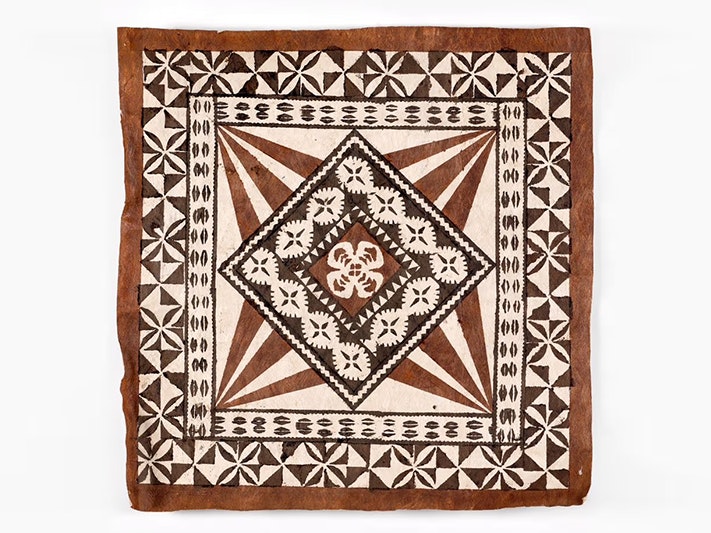
Liviana Qaranivalu is a masi or tapa artist from Fiji. You can see some of her work in Te Papa’s collections.