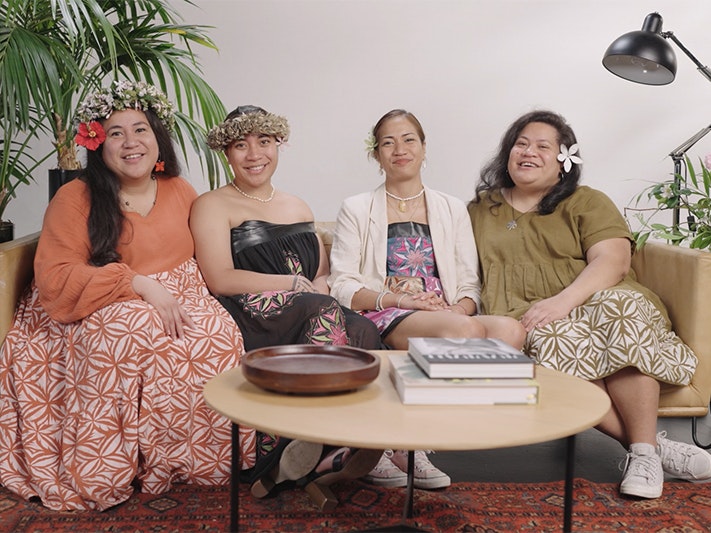
Watch: Kate Ngatokorua talks about the trope of the dusky maidens
Watch Kate Ngatokorua talk about how adornment influences her life as a Cook Islands woman, and the Western trope of Pasifika women being perceived and portrayed as anonymous exotic dusky maidens.
“[When I] talk to someone that hasn't met me before, and we talk about our life, and I mention that I am a Cook Island dancer, I am sexualised immediately because of the way that I can move my body, and they view you in such a different way. And so I've come to terms with it – that I am actually a dusky maiden. It hasn't changed. I'm still viewed in that way.” – Kate Ngatokorua
Watch Kate Ngatokorua
Please note: Select Māori for Cook Islands Māori subtitles on the YouTube video
Transcript
Expand All
Collapse All
Cook Islands Māori and Mangaian
Māori
English
Meet Kate
Tangi ke, tangi ke, ua matau ua oki tatou.
Kia Orana. My name is Kate Ngatokorua. I come from a small island in the South Pacific where there are more wild pigs than people. I was born, raised and educated on the island of Mangaia, which is the most southern island of the Cook Islands. I grew up surrounded by my language, culture and community and very proud to call Mangaia my home.
I have represented my island, and later my nation, in pageants both locally and overseas. I have loved dance since I was a toddler and could feel the rhythm of our songs and drums. The stage has always been my happy place. It would give me a freedom like none other, where nothing else would matter, and it felt like the world would be still for the minutes of a song or drumbeat.
I have always wanted to help my people and study something I was passionate about and through an expo in Rarotonga, I learnt about the Pacific Studies degree at Victoria University in Wellington. I graduated with a Batchelor of Art majoring in Pacific Studies and Cultural Anthropology with a minor in Tourism. In my third year, I learnt about the Whitireia Performing Arts programme, where I studied cultural dances and completed a Bachelor of Arts in Applied Arts.
I returned to the Cook Islands to work in culture and developed a passion for the history, reviving and preserving of our culture through archives and museums. I have had the privilege of working with Ngā Taonga Sound and Vision and Te Papa Tongarewa.
Currently, I am the Kaiako Pouwhakarite at the New Zealand Police Museum, where I continue to learn and feel that anyone I interact with who remembers one fact or leaves with a smile on their face means that I have done my job.
Our culture is a huge part of our identity. As people of the ocean, we have always passed on our stories from one generation to another. My hope and dream is for our people to have the ability to access and learn our culture for many generations to come. I am the person I am today because of the strength I have in my identity, and I hope many more of our people gain strength from their identity.
Watch Losalio Milika Pusiaki talk about how adornment influences her life as a Tongan woman, and the Western trope of Pasifika women being perceived and portrayed as anonymous exotic dusky maidens.
Watch the four Filo-Masoe sisters talk about how adornment influences their lives as Sāmoan women, and the Western trope of Pasifika women being perceived and portrayed as anonymous exotic dusky maidens.
Watch five interviews with eight Pasifika women examining the trope of the sensual ‘dusky maiden’ and the cultural significance of flowers in the Te Moananui-a-Kiwa Pacific Islands. Explore further through blog articles responding to the films, Te Papa collection images, and Pacific writing and media.