





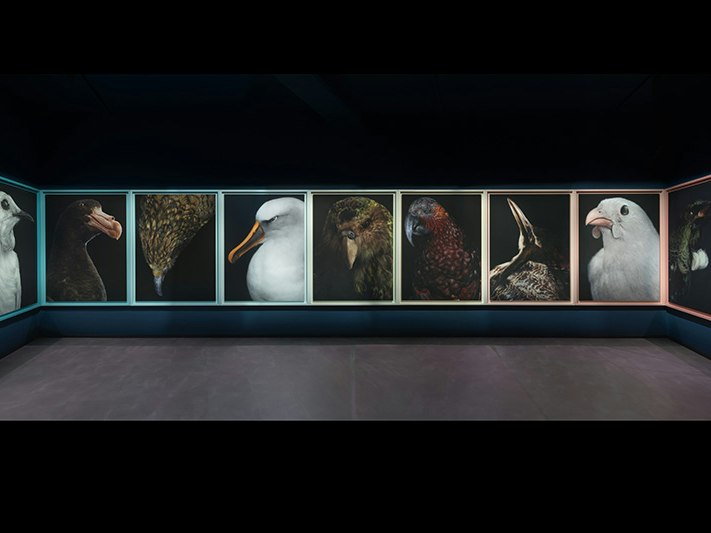
Taharaki Skyside: Fiona Pardington
Dr. Fiona Pardington’s Taharaki Skyside is the art exhibition at the Istituto Santa Maria della Pietà representing Aotearoa New Zealand at the Venice Biennale.
Free museum entry for New Zealanders and people living in New Zealand
Open every day 10am-6pm
(except Christmas Day)
Free museum entry for New Zealanders and people living in New Zealand
“An avian archipelago at the edge of the sky”
– Fiona Pardington | Te taha o te rangi (room sheet), Starkwhite, Tāmaki Makaurau Auckland, 2024
Learn more about Fiona Pardington's Te taha o te rangi series; the layered depth of meaning behind these striking portraits of taxidermied museum manu, and how they inspired her Venice Biennale work, Taharaki Skyside.
In 2024, photographer Fiona Pardington (Ngāi Tahu/Kāi Tahu, Kāti Māmoe, Ngāti Kahungunu, Clan Cameron of Erracht) created Te taha o te rangi, an exhibition of large portraits of taxidermied birds, each captured in such a way as to capture the charisma and mauri in these manu from times long past. This work was inspired by the natural history collections of South Canterbury Museum in Timaru, and a trip to see the seabirds of Antarctica.
The ideas introduced in Te taha o te rangi are further expanded on in Pardington’s 2026 Venice Biennale work, Taharaki Skyside. This article explores the development of some of those ideas.
Te taha o te rangi translates as ‘the edge of the heavens’. The horizon, where the land and sea meet, is the realm of manu but it is also the concept of a space in between. The blurry space between earth and sky, physical and spiritual, life and death. What seems like a sharp dividing line actually contains infinity.
“The edge, rather than the centre, appeals to me”, Pardington says, “the edge is still the centre and it unwinds forever, whichever distance covered or turn taken. East to west, north to south, the horizon is inexhaustible, unknown, and unreachable. Much like a rainbow, you chase it but will never catch it.”
This idea is echoed in how she captures the wairua of the manu in her images, “You’re not just witnessing it, or you’re not just staring at it. You’re not looking at it as some kind of finite object. There’s something of the infinite in it, the life force that’s still available … in the dusty remnants of a once-live little being.”
Pardington built upon this idea for her Venice Biennale work,Taharaki Skyside, inspired by the shared horizon between Aotearoa and Venice.
In both Te taha o te rangi and Taharaki Skyside, Pardington photographs the taonga through portraiture. This brings a sense of individual identity to these manu often treated simply as numbered specimens in the museums’ collections. The birds are photographed as living human subjects would be. Pardington explains, 'I call them portraits because animals, to me, have a personhood.
The gothic black frames around the artworks in Te taha o te rangi are a nod to those of the iconic New Zealand painter Charles Frederick Goldie, whose portraits of Māori tīpuna have sparked both controversy and connection for decades.
This choice places Pardington’s pieces within the wider context and story of Aotearoa art and culture.“[The Goldie-style frame] identifies the image it contains as a taonga, and as a portrait, and as an ancestor”, says Andrew Paul Wood, Art Historian and long-time Pardington collaborator.
In her newer work, Taharaki Skyside, Pardington expands on the idea of the frame as a contextual marker. Alongside the reference to the work of Goldie, she further explores the idea of the horizon as a liminal space, gracing these frames with the soft colours of a Venice sunrise.
In te ao Māori, birds act as spiritual messengers, able to travel between the physical and spiritual realms – across any horizon. As Pardington says, “they’re talking to the ancestors, they bring knowledge, they bring insight, they’re portentous.”
In both exhibitions Pardington places the birds as spiritual messengers once again. From across the horizon, from beyond their own mortality, they challenge us to see what we have lost, and all that we are on the edge of losing. They ask us: How can we continue to find and reaffirm that fundamental aspect of our humanity; of balance with the natural world?
Both Te taha o te rangi and Taharaki Skyside speak to conservation through a Māoritanga lens. In generations past, native manu served as both a symbol and a resource, acknowledging the way we are interconnected with nature – a connection that seems ever-diminishing in the world around us today. That connection is made visible in Taharaki Skyside, with Pardington utilising digital manipulation to place a reflection in the birds’ eyes of the landscapes they once lived in.
Watch the two short interviews below, where Fiona Pardington discusses Te taha o te rangi pieces with art historian Andrew Paul Wood.
Read more about Te taha o te rangi at StarkWhite Gallery.
Dr. Fiona Pardington’s Taharaki Skyside is the art exhibition at the Istituto Santa Maria della Pietà representing Aotearoa New Zealand at the Venice Biennale.
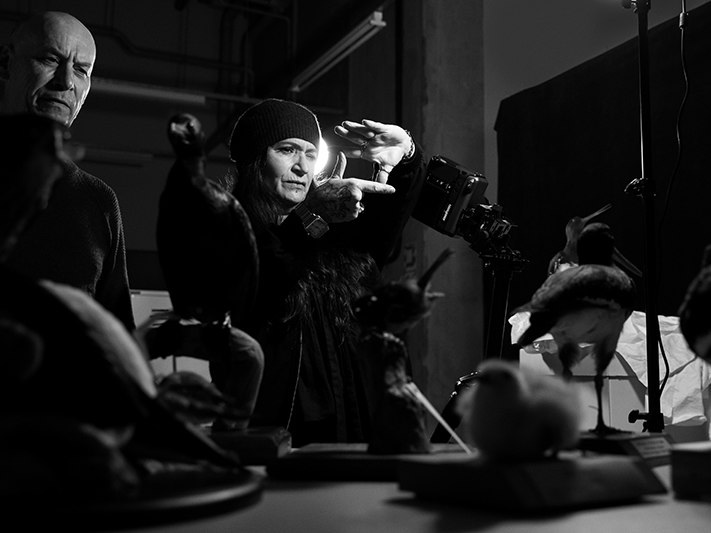
Fiona Pardington's photography is shaped by her Ngāi Tahu whakapapa (ancestry), te ao Māori, and a deep curiosity for the stories that objects, people, and places can hold. Through careful research and technical skill, her work invites us to reconsider history, memory, and our relationships with the natural world.
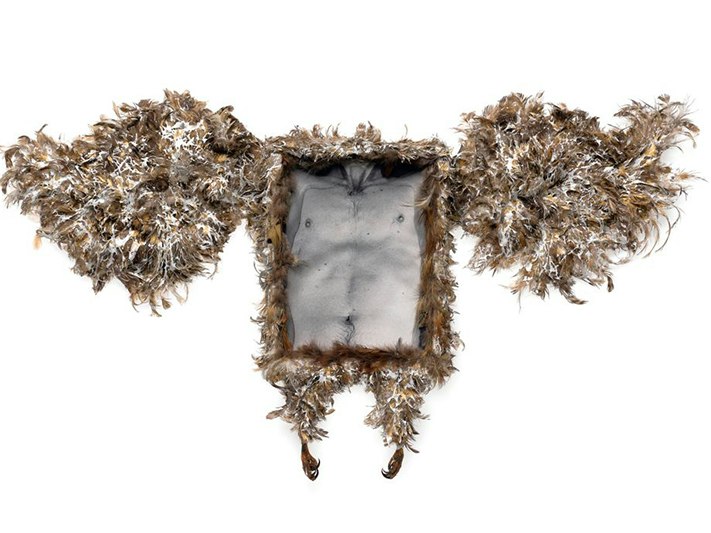
See some artworks by Fiona Pardington held by Te Papa.