




How the tools and process of tāmoko changed
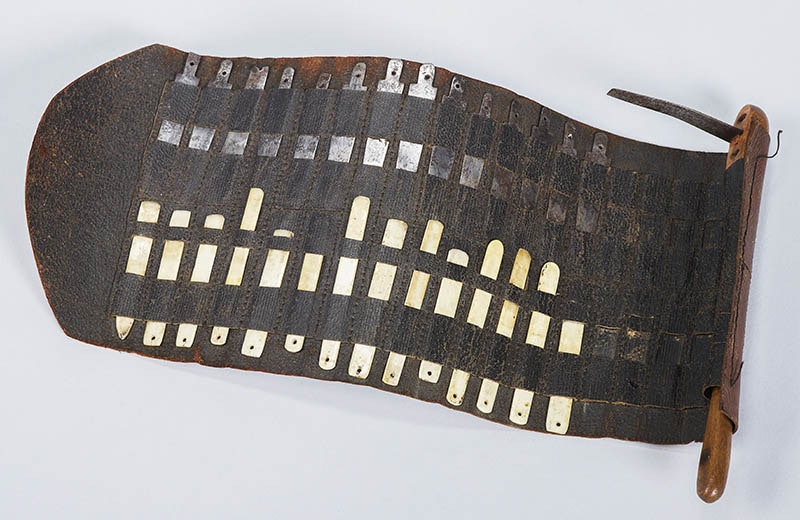
The tattooing process itself changed early in the contact period, and certainly by the 1840s metals started to replace bone in the manufacture of uhi, tattooing chisels, and combs.
Free museum entry for New Zealanders and people living in New Zealand
Open every day 10am-6pm
(except Christmas Day)
Free museum entry for New Zealanders and people living in New Zealand
Discover the history and practice of tāmoko, and find out why the lines of a moko carved in skin represent much more than a tattoo.
The Western and Eastern Pacific method of tattooing is based on the use of broad-toothed combs of varying widths called uhi, dipped in dark pigment, and struck into the skin with small mallets known as tā. The teeth of the comb pierce the skin and deposit the pigment. Māori brought this method of tattooing with them from Eastern Polynesia.
As the art and practice of tāmoko (also known as tā moko) developed in isolation in Aotearoa New Zealand, Māori pioneered the use of smaller, narrower uhi without teeth that cut grooves through the skin.
Uhi Tā Moko (tattooing instruments), 1800-1900, New Zealand. Te Papa (WE000300)
This process was followed by the application of small, toothed uhi combs that applied the pigment. This method of tāmoko applied to the face is a form of scarification, which in practice is very similar to wood carving, and is characterised by deep grooved furrows stained with dark pigment.
The meaning and significance of these design motifs appears to be a complex interplay between high aesthetic and a visual language that underscores artistic excellence, identity and role.
Many of the design motifs are universal, especially the spiral elements applied to the ihu, cheek, and lower jaws, and the curvilinear rays on the forehead and from the nose to the mouth. The remaining elements were carefully chosen to accentuate and enhance the individual features, giving meaning to the expression Mataora, the living face.
Moko may also indicate social status, role, and expressions of identity though genealogy, but this remains unclear.
Tā moko, 1906, by Leslie Hinge. Te Papa (B.000832)
Tāmoko has undergone significant changes since its practice was disrupted through colonisation and the adoption of Christianity in the mid-19th century.
Missionaries, and Pākehā generally, perceived it as a distasteful practice, even while being somewhat fascinated by it.
Sydney Parkinson, Head of Otegoowgoow. Son of a New Zealand Chief, the curiously tataoued. Plate 21. From the book: A journal of a voyage to the South Seas, in his Majesty’s ship the Endeavour, 1784. Te Papa (RB000268/109a)
This view particularly affected a young generation of Māori men specifically, and to a lesser extent women.
The last men to be tattooed during this period died during the 1920s, but women from various districts continued to be tattooed through to the 1920s.
It’s important to note that it’s impossible to discuss moko in contemporary New Zealand society without mentioning the hugely significant role that our Sāmoan whanaunga, our Pacific cousins, have played in revitalising tāmoko, especially pūhoro, in generously sharing their knowledge and mentoring Māori in the practice of customary tatau.
The tattooing process itself changed early in the contact period, and certainly by the 1840s metals started to replace bone in the manufacture of uhi, tattooing chisels, and combs.

Te Papa is home to many precious carved taonga (treasures), including the three-dimensional faces of the Tā Moko panel carved by Ngāti Tarāwhai master carver Tene Waitere, a master carver from Lake Rotoiti. Then Curator Arapata Hakiwai talks with James Schuster, the great-great-grandson of Tene Waitere, about the panel.

Experience over 140 whakairo (carvings) spanning seven centuries – many never exhibited before. He Toi Whakairo: The Art of Māori Carving showcases creativity, ancestral narratives, and contemporary innovation. Every carving is an expression of artistic excellence and human dignity.
On now
29 Aug 2026 – August 2031
Exhibition Ngā whakaaturanga