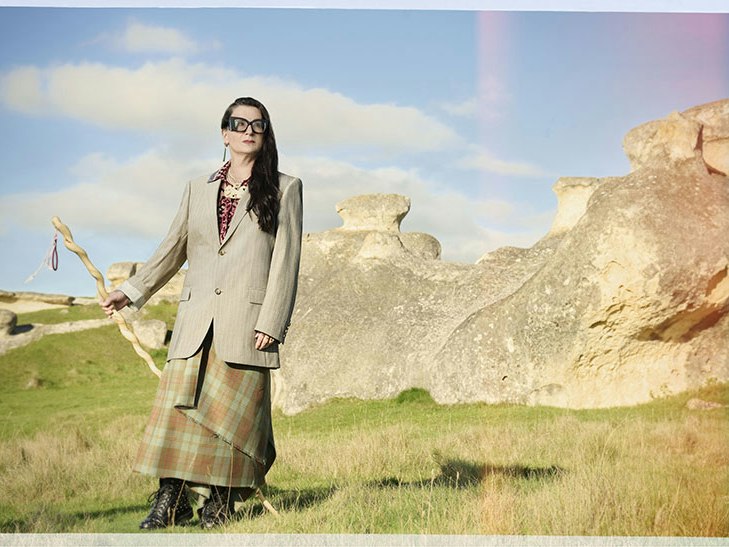
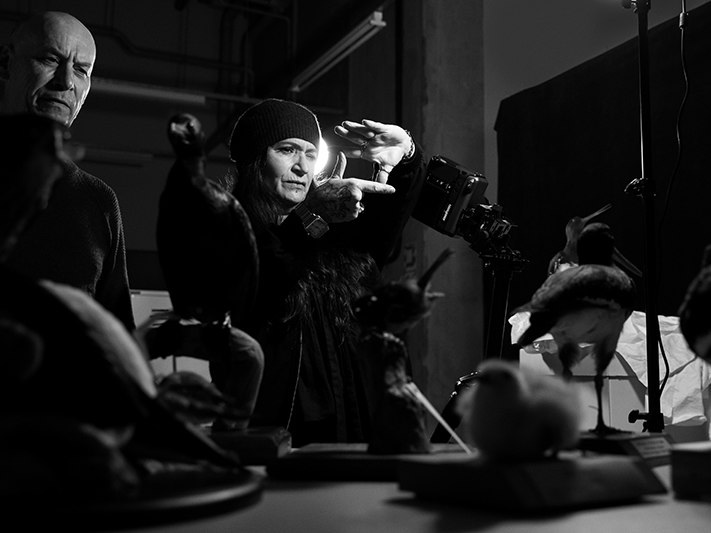
This essay, Soul Frequencies1by Te Papa Curator Art Megan Tamati-Quennell, was originally published in Fiona Pardington: Taharaki Skyside by Christchurch Art Gallery.
Mā te huruhuru ka rere te manu Adorn the bird with feathers so it can fly. 2
In Taharaki Skyside, the horizon is imagined not just as a view or a line of sight, but as a liminal space between worlds – a threshold both physical and metaphysical; a portal to the infinite. For Fiona Pardington, the horizon is a synchronisation point: a place where mortality meets transcendence, and where potential vibrates outwards into other dimensions and imperceptible worlds.
Taharaki Skyside contributes to the “collective score” of In Minor Keys, the curatorial vision of the late Koyo Kouoh, artistic director of the 2026 Venice Biennale.3 Kouoh proposed a space of “quiet resistance through contemporary art”, attuned to the discreet and the unobtrusive, rather than “the anxious cacophony of the present”.4 She envisioned In Minor Keys as a biennale that would resonate with the strange, the melancholic, the poetic and the emotional – qualities that have long underscored Pardington’s practice.
“I want my photographs to be more than name, form or concept. I want them to be a piece of my life, an image connected with me – by the bridge of emotion.”5
In her curatorial notes, Kouoh described her project as a site for “artistic practices that open portals, that refresh and nourish, that prompt relation and relationship”; practices linked, she suggested, to “soul frequencies”, communal universes and “other worlds”.6
The notion of soul frequencies is prominently expressed in Pardington’s practice. Curator Aaron Lister observed that her photography “has always been open to the forces that connect material and immaterial realms”. Her practice, he proposed, is centred on “the personal, cultural and symbolic modes of exchange that photography makes possible”.7 Pardington brings together the seductive allure of photography with an intimacy carefully constructed between herself and the subjects she portrays. In this way, her lens is not simply a recorder but a resonant instrument, tuned to the vibration of mauri – life forces or “soul frequencies”.
Whether photographing taonga (Māori cultural treasures), plaster life casts, natural history specimens – shells, feathers, bones, the fragile remains of an extinct bird – or a block of Taniwha soap, Pardington redeploys her images, moving them beyond their muted silence. Her work expresses the communicative vitality of her subjects, returning both their mauri and mana (prestige and status), enlivening them with sensuality and spirit. Although a throughline within her oeuvre, this dimension of her practice is perhaps most powerfully realised in her engagements with museum collections in Aotearoa New Zealand and internationally.
Pardington’s work with museum collections began in 2001 with Mauria Mai, Tono Anō, a series of seven tiki reclaimed from Tāmaki Paenga Hira Auckland Museum. These tiki, belonging to Ngāi Tahu – the Te Waipounamu South Island tribe that Pardington shares whakapapa, or genealogy, with – were retrieved from the obscurity of the storeroom and, as the title suggests, brought back and into the light. She deliberately claimed and selected the broken and forgotten tiki that sat in drawers, unseen by the public; the orphaned or unprovenanced taonga that were rarely used for exhibition. Carefully staged, lit and shot using long exposures, her photographs revealed the intensity of the human forms carved from pounamu and released them from their ethnographic stasis. Her images captured the tiki – originally worn against the skin – as individual portraits: “fugitive beings”8 imbued with personality, depth and ancestral mana.
“All the silence, the loss, the fear and crisis, my mother’s broken heart and black eyes, the forgetting and hiding from my childhood about my Ngāi Tahu roots lift incrementally as I finish each project. I am trying to learn who I am and it is from the blood that flows through my veins that the voices come.”9
Among her museum works are Pardington’s manu, or birds. Her first avian portraits were created using birds from the Museum of New Zealand Te Papa Tongarewa, Canterbury Museum and later the Whanganui Museum. Focused on the ornithological collections, she created close-cropped images of the taxidermied birds, realising each portrait as a melancholic and haunting elegy about ecological devastation and species loss. Another series employing this mode of making is Eight Shells from 2004, drawn from a collection held at Otago Museum gathered by South Island historian, ethnologist and collector James Herries Beattie (1881–1972). The shells feature the species name and the location where the shell was sourced or can be found, handwritten in pencil in te reo Māori by a taua, a senior Ngāi Tahu woman who was an informant to Beattie.
‘Shy, spidery copperplate words cupped in wave-tumbled, sea-bleached shells […] pencilled graphite names, effortlessly poetic and often functioning as a tiny manual for proper use.”10
Further projects employing this mode include photographs realised for Pardington’s exhibition in the 2nd Auckland Triennial in 2004. Her show Te Horo / To be Shattered used the bird reference collection at Te Papa, a ‘shadow collection’ which features bones, feathers and incomplete remains. In her photographs, she intentionally isolated the elements and presented the imperfect parts she had selected. Using tonal shifts of matt black, soft grey, silver and glaring white, Pardington created her images, taken in close-up detail or dreamy soft focus, so their original form was ethereal, obscure, unrecognisable, perhaps unknowable. A continuation of the quiet of these shell, feather and bird works, The Heart Derelict was a 2006 exhibition of photographs of native and exotic bird nests sourced from the compendium of Otago Museum, which she poured care and attention into and presented as living forms. “For Pardington, the nest is a transformative place, a mystical space in a constant state of flux […] each unique in character and appearance.”11
Of critical importance to this context are Pardington’s Āhua: A Beautiful Hesitation photographs, first shown in the 17th Biennale of Sydney in 2010 and later the focus of her major exhibition The Pressure of Sunlight Falling, which debuted the following year at the Govett-Brewster Art Gallery in Ngāmotu New Plymouth. The series featured nineteenth-century life casts, held in the Musée de l’Homme in Paris. made during French explorer Jules Dumont d’Urville’s second voyage to the Pacific in the late 1820s. A proto or pre-photographic form of portraiture, Pardington’s evocative reimagining of the plaster life casts as photographic portraits restored the individuality, dignity and mana of the people whose likenesses were captured – including three Ngāi Tahu rangatira (leaders): Piuraki, Takatahara, and Heroua.
What unites these diverse bodies of work is not only the artist’s hand and eye, but Pardington’s distinctive aesthetic approach and conceptual intent. Hallmarks of her practice – staged portraits, judicious lighting, the classical rendering of exalted still lifes and a reparative resolve – have shaped her images with purpose. Her restorative determination extends beyond formal aesthetic qualities to an active consideration of whakapapa, the genealogies and histories of the taonga she is working with, and the complex “tension between photography and taoka Māori”.12 Along with this unsettled relationship is Pardington’s regard for the prior lives of the taonga, objects or natural history specimens – their wairua, spirit and soul.
Throughout the 24 years of this part of Pardington’s practice, she has continued to interrogate the frameworks of museology: its settings, classifications and disciplinary milieu, including the ethnographic containment of cultures and peoples and the ways these institutions have deadened cultural power and practice. She has explored the histories of pseudo-science – most notably phrenology, which “maps the topography of the skull”. Her focus was on the life casts held as archival objects in the Musée de l’Homme – “originally intended to illustrate a hierarchical and deeply racist classification of the peoples of the Pacific”.13 Pardington’s Āhua portraits drew out the alternative layered meanings and associations of the life casts and returned their humanity to them. This project was of particular value to Ngāi Tahu. The Ngāi Tahu life casts, which she was made aware of in 2007 by Ōtākou leader Tahu Potiki, were the catalyst for the larger project. Pardington’s reimaging of the Ngāi Tahu tīpuna (ancestors) emblematically brought their āhua – likeness, presence or being – home.
Taharaki Skyside builds on Te Taha o Te Rangi, showcased at the Aigantighe Art Gallery in Timaru in 2024, an exhibition about Aotearoa as “an avian archipelago at the edge of the sky”.14 Her offering for Venice combines taxidermied birds and horizons. These manu are liminal presences, creatures who have always bridged earth and sky, transience and transcendence. They embody the Māori concept of kaikaranga wairua as spiritual messengers operating between worlds, between the living and the dead.
Frozen and motionless in the museum, Pardington’s taxidermied birds are vessels of paradox – death masquerading as life and occupying a space “between love and death and fetish”.15 Like her expanded practice, her portraits do not simply record, they transfigure and transform. They speak relationally of the manu as kin and as significant beings within Māori culture. Birds were formative in Aotearoa New Zealand’s pre-human history and pre-colonial Māori life. They feature in ngā tuhituhi whenua o Ngāi Tahu, the rock drawings of Ngāi Tahu, found in Te Waipounamu, the South Island, which are among the earliest art in the country. They are referenced in foundational Māori creation stories – like Hinenuitepo, the Atua or deity associated with both dreams and death that features the Tīwaiwaka or Fantail, in te reo in the form of tauparapara at the beginning of a mihi (greeting) used in Māori ritual and ceremony, in allegorical prose and in waiata, or song. They were also an important food, with birds like tītī still a culinary and cultural delicacy. Their feathers are used in our finery, in Māori clothing to create kahu huruhuru or kahu kiwi– prestigious cloaks – and in other forms of adornment, worn on our bodies, or in our hair.
Ka tangi te tītī. Ka tangi te kākā. Ka tangi hoki ahau. Tihei mauri ora! The Mutton bird cries. The Parrot cries, I also cry! Behold there is Life!16
Pardington’s photographs re-animate the manu, offering them a further life that acknowledges their transition from once-living beings to colonial objects of natural history, and now, in her hands, as sublime presences of mana and dignity. Her manu portraits are never simply specimens; each exposure lifts the taxidermied birds from stillness, rendering them as matter and spirit, as mortal and boundless. The birds in her work are holders of “familial love, romantic attachment [and] ecological warnings”.17 They are reminders of our own mortality, their preserved fragility, tohu – urgent signs – that speak of the environmental calamity that is underway.
Pardington’s vision is simultaneously intimate and vast. Each image created for Venice is personal and familial, or collective – cultural, ecological or spiritual. Taharaki Skyside speaks across hemispheres. It collapses distance and time and stretches out from Aotearoa New Zealand and the Pacific Ocean to the archipelago of Venice. Dante’s Purgatoria, with its references to “the sea, stars, exploration, and the Earthly Paradise”,18 meshes with Pardington’s own thinking and anchors her project in Italy; in place. By bringing horizons, birds and the lens into a constellation, Pardington creates a poetic proposition; one that situates the infinite not as abstraction, but as a powerful presence, intertwined with otherworldliness and manifest in her bird portraits, in shifting light, in soul frequencies and in the liminal zone of the threshold.
Megan Tamati-Quennell, CNZM, is a leading art curator and writer from Aotearoa New Zealand. Of Te Ātiawa, Ngāi Tahu and Kāti Mamoe descent, she has a 35-year curatorial practice specialising in Māori and First Nations art.
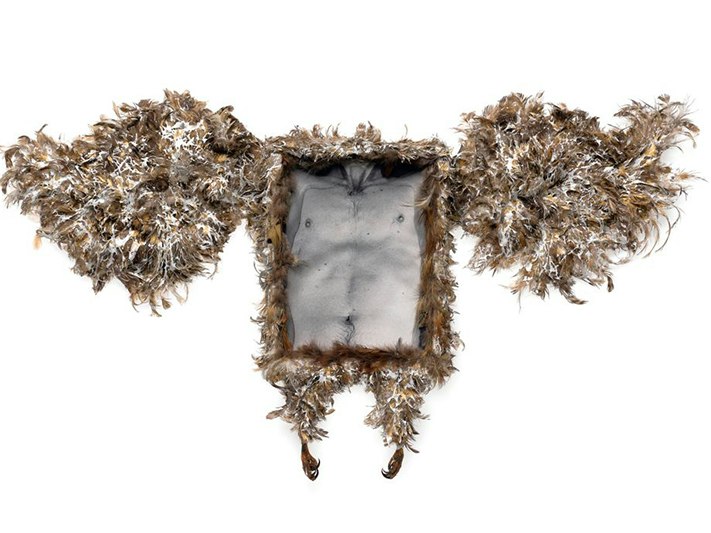
Huia love triangle, by Fiona Pardington; photographer; 2006. Purchased 2009. Te Papa (O.032996)
Taniwha, by Fiona Pardington; photographer; 1996; Auckland. Purchased 1999 with New Zealand Lottery Grants Board funds. Te Papa (O.018722)
References
1. “Soul frequencies” was a term used by Koyo Kouoh (1967–2025), appointed curator of the 2026 Venice Biennale. See Kouoh, ‘In Minor Keys’, La Biennale di Venezia, undated, labiennale.org/en/art/2026/curatorial-text-koyo-kouoh.
2. This whakataukī, or Māori proverb, is about potential and how, with the right support and resources, potential can be achieved.
5. Fiona Pardington, Fiona Pardington: A Beautiful Hesitation, Victoria University Press, Te Whanganui-a-Tara Wellington, in association with City Gallery Wellington and Auckland Art Gallery Toi o Tāmaki, 2016, page 80.
6. Kouoh, ‘In Minor Keys’.
7. Aaron Lister, ‘Love never faileth: The shape of a practice’, in Fiona Pardington: A Beautiful Hesitation, pages 12, 17.
8. Fugitive Beings, was the title of a series of works related to birds created by Pardington in 2004.
9. Pardington, quoted in Kriselle Baker and Elizabeth Rankin, ‘In search of the present: Fiona Pardington’s Āhua, Fiona Pardington, The Pressure of Sunlight Falling, Otago University Press, Ōtepoti Dunedin, in association with Govett-Brewster Art Gallery and Two Rooms Gallery, 2011, page 13.
10. Pardington, Fiona Pardington: A Beautiful Hesitation, page 132.
11. Gina Irish, The Heart Derelict (exhibition catalogue), Otago Polytechnic, Ōtepoti Dunedin and Jonathan Smart Gallery, Ōtautahi Christchurch, 2008, page 5.
12. Pardington, quoted in Lister, Fiona Pardington: A Beautiful Hesitation, page 17.
13. Susan Best, ‘Fiona Pardington’s photography, Life, love, libido’,Fiona Pardington: A Beautiful Hesitation, page 32.
14. ‘Fiona Pardington | Te Taha o Te Rangi’ (room sheet), Starkwhite, Tāmaki Makaurau Auckland, 2024, starkwhite.co.nz/exhibition/fiona-pardington-te-taha-o-te-rangi.
15. Ibid.
16. A tauparapara commonly used at the start of a mihi, or greeting.
Step into the work of renowned Māori photographer Fiona Pardington and you'll discover images that are beautiful, haunting, and deeply contemplative. Her photographs invite us to see familiar objects and themes in new ways – not as disconnected artefacts, but as powerful messengers of whakapapa (ancestry), history, and symbolism.
Fiona Pardington's photography is shaped by her Ngāi Tahu whakapapa (ancestry), te ao Māori, and a deep curiosity for the stories that objects, people, and places can hold. Through careful research and technical skill, her work invites us to reconsider history, memory, and our relationships with the natural world.